Utah Legislature – 2026 General Session Wrap Up
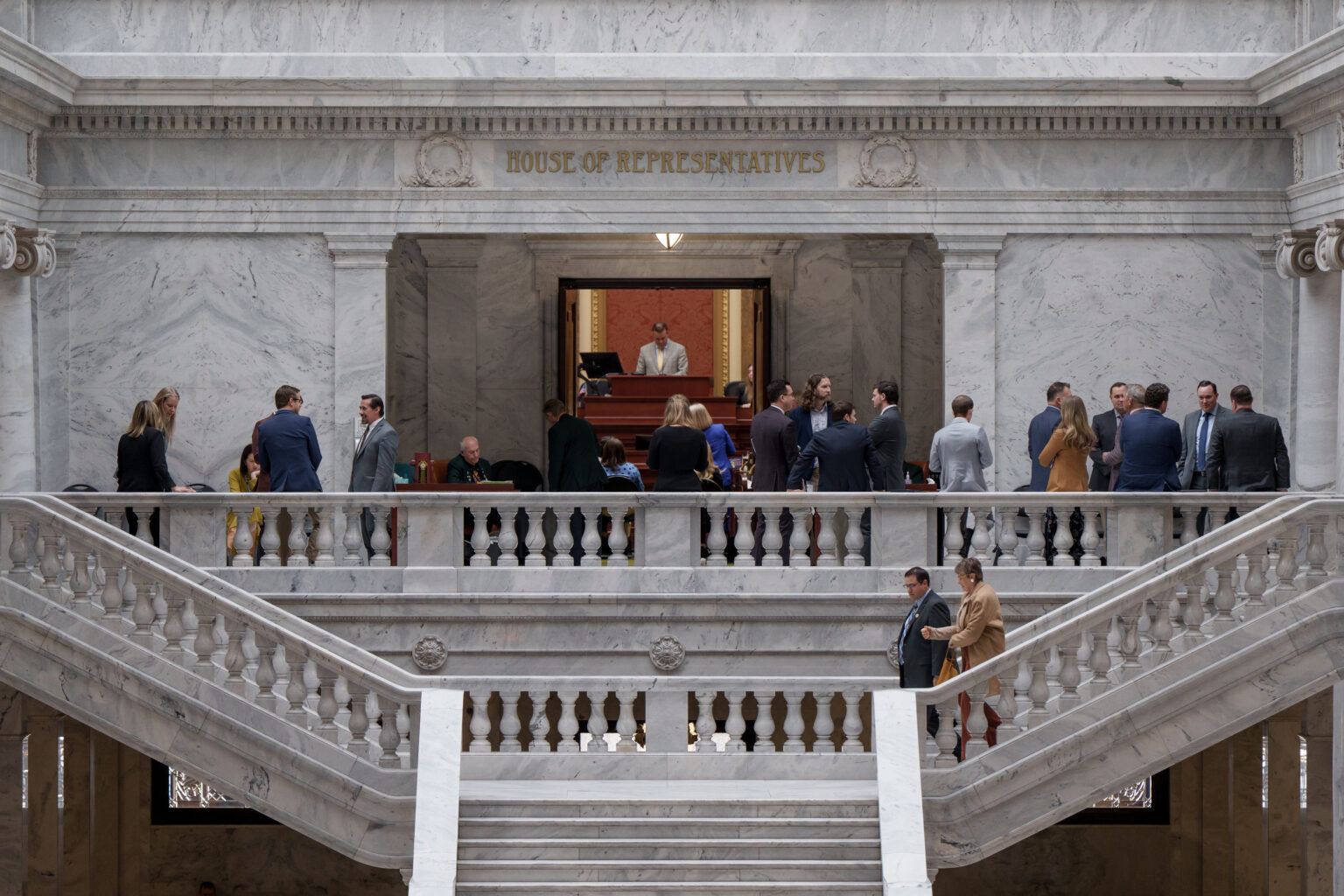
People congregate outside of the House Chamber at the Capitol in Salt Lake City on Thursday, Feb. 19, 2026. (Photo by Spenser Heaps for Utah News Dispatch)
At midnight on March 6 the Utah Legislature adjourned sine die after passing 542 total bills – approximately 53% of the 1,015 bills introduced this session. A full list of bills that passed the Legislature and were sent to the Governor may be found here. The Governor has 20 days following adjournment to take action on the bills that passed.
While the Governor has vetoed a number of proposals in past years, in a recent interview Governor Cox dubbed the 2026 Session as the “best session” he’s been involved in as Governor. This is high praise in itself, and when paired with positive feedback from across the political aisle, including Salt Lake City Mayor Erin Mendenhall stating this was “one of the most productive legislative sessions that we’ve had,” it reflects the largely positive responses to the legislature’s efforts over the 45-day session and the enacted policies that will continue to shape the entirety of Utah’s landscape.
As is often the case, what did not pass this session was equally important as what did pass. This session, the legislature appears to have struck the right balance between enacting policies with industry support, working with business and industry associations to reach workable compromises on key issues, and pausing proposals that require additional time for negotiation.
Below we have provided an overview of the final outcomes for the bills of interest highlighted in our weekly updates and provided additional resources for issue and industry specific legislative recaps.
A final thanks to members of the business community for dedicating time and resources to engage in the legislative process. Sharing your technical expertise helps legislative proposals find their mark, limits unintended consequences, and ultimately shapes stronger policy outcomes.
Outcomes on Priority Bills from Legislative Watchlist
In our weekly updates throughout the session, we have included a number of “bills we are watching,” and referenced proposals of particular significance. Below we have compiled a table overviewing the final outcomes for each of these proposals.
| Policy Area | Bill Number & Title | Sponsor | Final Version | Description | Outcome |
| Business | HB 175: Public Funds and Political Activities Amendments | Rep. Trevor Lee | Original | This bill would have prohibited an entity from receiving a government contract or state grant if they: participate in a political campaign, devote more than an insubstantial part of the entity’s activities to attempting to influence legislation, or if their primary objective can only be attained by legislative action or inaction. It would prohibit a current or prospective government contractor or grant recipient from making a contribution to a political entity or to another person for a political purpose. | Did Not Pass |
| Business | SB 179: Wage Amendments | Sen. Nate Blouin | Original | If enacted, this bill would require that an employer include information relating to wages and other compensation in a job listing; increases the minimum wage in the state to $20 per hour; prohibits that the Labor Commission from establishing a minimum wage that is lower than $20 per hour; requires that the commission adjust the minimum wage for inflation at least once per year. | Did Not Pass |
| Business / AI Pricing Regulation | SB 293: Consumer Pricing Data Amendments | Sen. Heidi Balderree | 1st Sub. | This bill would have restricted suppliers from using a consumer’s personal data (biometrics/purchase history) to set prices for goods or services; established a three year retention of data used by the automatic pricing system; provided enforcement mechanisms for the Division of Consumer Protection; among other provisions. The 1st Sub. was not adopted and the bill failed to pass out of the Senate. | Did Not Pass |
| Business / AI Pricing Regulation | SB 177: Product Pricing Amendments | Sen. Stephanie Pitcher | 1st Sub. | This bill would have required suppliers to display disclaimers when using algorithmic pricing to set the price of goods or services (with exceptions) and provided the Division of Consumer Protection enforcement power. | Did Not Pass |
| Business / Consumer Protection | HB 29: Unfair and Deceptive Pricing Amendments | Rep. Tyler Clancy | Original | This bill would have prohibited hidden fees by requiring the clear and conspicuous disclosure of the total price in an offer or advertisement of a product; | Did Not Pass |
| Business / Labor & Employment | HB 203: Noncompete Amendments | Rep. Tyler Clancy | 1st Sub. | This bill was a key focus of the business community this session. If enacted, the bill would prohibit employers from enforcing a non-compete agreement if the employee is: nonexempt, a full-time student engaging in an internship or other short-term employment, eighteen years or younger, their total earnings are less than $155,000 per year, or if the agreement would restrict an employee’s ability to work more than 25 miles from a specific geographic location. The 1st Sub. of the bill reflected some of the changes requested by the business community, including removing the garden leave clause but ultimately the bill pulled from the House 3rd Reading Calendar by the Sponsor to allow more time for discussions and negotiations with the business community over the interim | Did Not Pass |
| Civil Law / Tort Reform | SB 211: Tort Amendments | Sen. Kirk A. Cullimore | 1st Sub. | This was a priority concern for the business community. If enacted, this bill would have: 1. Limited what juries can hear about insurance and paid medical bills. 2. Prevented settlement decisions based on discounted medical costs. 3. Increased potential liability exposure and insurance costs, which could ultimately increase insurance costs for Utah businesses. | Did Not Pass |
| Civil Law / Tort Reform | SB 280: Damages Amendments | Sen. Ronald Winterton | Original | This bill would have established a statutory framework for the determination of recoverable medical damages in civil actions in alignment with core holdings from the Utah Supreme Court’s ruling in Gardner v. Norman (October 2025) and was viewed by the business community as a reasonable alternative to various tort reform proposals. | Did Not Pass |
| Critical Minerals | SB 254: Extracted Natural Resources Amendments | Sen. Ann Millner | 4th Sub. | This bill was one of the most significant policies of the 2026 session and establishes the statutory framework to catalyze the state’s goal of becoming a major global producer of critical minerals. Facilitates faster permitting by the Department of Environmental Quality and the Division of Oil, Gas, and Mining; establishes the Critical Minerals Council, including establishing the council’s operations, powers, and duties; addresses areas of coordination by certain council members, establishes a process to designate critical mineral zones, including providing for property tax differential revenue; provides for the creating of a clearinghouse of data to be known as the “Critical Minerals Atlas”; addresses the creation of the Minerals for Industrial, National, and Economic Security Center; creates the Critical Minerals Development Account; and modifies the tax credit for mining exploration, among other provisions. | Passed |
| Gov. Operations | SB 298: Programmable Money Amendments | Sen. Keven Stratton | Enrolled | This bill: defines terms; excludes programmable money from the standard definition of money; prohibits a person from requiring the use of programmable money for a transaction unless the person also offers a free, non-digital alternative, among other provisions. | Passed |
| Housing | HB 68: Housing Amendments | Rep. Cal Roberts | 6th Sub | Consolidates existing state housing programs into one entity under the Governor’s Office of Economic Opportunity and creates the Division of Housing and Community Development within the GOEO. | Passed |
| Immigration | HB 571: Immigrant Amendments | Rep. Trevor Lee | Original | This bill would have prohibited money transmitters from sending funds for unauthorized aliens. | Did Not Pass |
| Labor & Employment | HB 294: Employer Verification Amendments | Rep. Tiara Auxier | Amended | This bill would have lowered the employer verification threshold from 150 to 100 employees, requiring private employers who employ 100+ employees to register with a status verification system to verify the federal legal working status of any new employee after July 1, 2027. The bill originally set the threshold at 50 employees and was amended multiple times to increase the proposed threshold to 100, then 125 employees before failing. | Did Not Pass |
| Labor & Employment | HB 245: Construction Wage Standard Act | Rep. Tyler Clancy | 1st Sub. | This addressed wage standards for construction projects; directed the Labor Commission to determine the wages for the occupations a construction project required for each county; established: a wage minimum that a contractor may pay a qualifying employee; a recordkeeping requirement; and the penalties for noncompliance; and made technical and conforming changes. | Did Not Pass |
| Land Ownership | HB 291: Security and Land Restriction Amendments | Rep. Candice Pierucci | Amended | This bill would lower the percentage of ownership a restricted foreign entity may maintain in a separate entity before the separate entity is considered a restricted foreign entity from 51% to 25% ownership interest. | Passed |
| Taxes | HB 161: Property Tax Modifications | Rep. Jill Koford | Original | If the accompanying referendum HJR 7 was passed by voters, this bill would have increased the residential property tax exemption from 45% to 60% and likely shifting a greater portion of the tax burden from residential to commercial properties. | Did Not Pass |
| Taxes | SB 60: Income Tax Rate Amendments | Sen. Dan McCay | Original | This bill amends the income tax rate provisions and reduces the corporate and individual income tax rates from 4.5% to 4.45% for the 2026 tax year. | Passed |
| Taxes | HB 441: Property Transaction Amendments | Rep. Jill Koford | Original | This bill would have required the seller or the closing agent make available information about the property, including sales price, to a county | Did Not Pass |
| assessor when ownership of property is transferred. | |||||
| Taxes | HB587: Income Tax Amendments (R&D Expensing Decoupling) | Rep. Steve Eliason | Sub. 2 | If enacted, this bill would lower Utah’s corporate and individual income tax rate from 4.5% to 4.45% and create a Utah add back for domestic research and development expenses if they are fully deducted federally, allowing these expenses to be amortized over 60 months. The 2nd Sub. for this bill removed the R&D decoupling provisions. | Did Not Pass |
| Taxes | SB 116: Income Tax Rate Modifications | Sen. Lincoln Fillmore | 1st Sub. | This bill would have allowed for a reduction of the income tax when the state revenue exceeded the forecasted revenue. | Did Not Pass |
| Taxes | SB 287: Targeted Advertising Tax | Sen. Mike McKell | Enrolled | This bill creates a new statewide tax on targeted digital advertising delivered in Utah by large advertising platforms and establishes a dedicated revenue stream to fund specified youth and community programs. Beginning January 1, 2027, an annual tax will be levied on “targeted advertising entities. | Passed |
| Taxes/Child Care | HB 190: Childcare Business Tax Credit | Rep. Jason Thompson | 2nd Sub. | This bill increases the amount of nonrefundable corporate and individual income tax credits to 30% of the qualified child care expenditures if they qualify as an eligible small business; repeals the requirement for an employer to have claimed the tax credit for construction expenditures in order to claim the tax credit for child care expenditures. | Passed |
| Technology / AI | HB 286: Artificial Intelligence Transparency Amendments | Rep. Doug Fiefia | 1st Sub. | This bill would have enacted the AI Transparency Act relating to transparency and whistleblower protections for frontier artificial intelligence models and required “large frontier developers” to publish safety plans for chatbots with 1M+ subscribers, publish summaries of risk assessments for certain AI models; file reports with Utah’s Office of Artificial Intelligence Policy, among other provisions, and would have established civil penalties for violations. The bill sponsor pulled the bill from consideration due to a formal request from the White House to Legislative Leadership to not move forward with the proposal. | Did Not Pass |
| Technology / AI | HB 438: Artificial Intelligence Amendments | Rep. Doug Fiefia | 5th Sub. | If enacted, this bill would have enacted the Companion Chatbot Safety Act to regulate operators of companion chatbots and protect consumers. This bill: defines terms; requires operators of companion chatbots to comply with the Utah Consumer Privacy Act; establishes disclosure and data protection requirements for operators; establishes additional safety requirements for operators serving minor users; authorizes rulemaking for age assurance and safe harbor standards; requires annual reporting by operators to the Office of Artificial Intelligence Policy; grants enforcement authority to the Division of Consumer Protection; provides for administrative fines and civil penalties; establishes safe harbor provisions for operators; and provides a severability clause. | Did Not Pass |
Industry and Issue Specific Legislative Recaps
For additional reference, we have compiled a list of issue specific legislative recaps and analysis of major policy developments during the 2026 Utah General Legislative Session. These resources were prepared by industry associations, universities, media outlets, advocacy organizations, and government agencies.
We are grateful to the authors and organizations listed below for their insights into legislative outcomes across key policy areas including tax policy, natural resources, energy, housing, education, and local government affairs.
Business, Taxes, and State Budget
Utah Chamber of Commerce.
2026 Legislative Update: Week 7. Utah Chamber of Commerce.
https://www.utchamber.com/blog/2026-legislative-session-week-7-update/
Deseret News.
“Why Don’t Utah Lawmakers Cut Property Taxes?” Deseret News.
https://www.deseret.com/utah/2026/03/05/why-utah-lawmakers-dont-cut-property-taxes/
Utah Governor’s Office of Planning and Budget.
Sine-Nara to the 2026 Utah General Session. State of Utah Budget Office.
https://budget.utah.gov/sine-nara-to-the-2026-utah-general-session/
This post summarizes the state budget adopted by the legislature, including tax policy changes and major appropriations. The FY 2027 state budget totals approximately $31.6 billion, including $12.4 billion from state funds.
KSL News.
“Here Are the Biggest Spending and Tax Cuts Approved by the Utah Legislature This Year.” KSL.com.
https://www.ksl.com/article/51457411/here-are-the-biggest-spending-and-tax-cuts-approved-by-the-utah-legislature-this-year
Natural Resources, Water, Air Quality, and Land Use
Utah State University – Institute of Land, Water, and Air.
This Week in Utah’s Land, Water, and Air — March 6, 2026. Utah State University.
https://www.usu.edu/ilwa/
Deseret News.
“A Look at Utah’s Biggest Environment and Land Bills in 2026.” Deseret News.
https://www.deseret.com/utah/2026/03/07/utah-environment-land-bills-2026/
Transportation, Infrastructure, Planning, and Regional Development
Wasatch Front Regional Council.
2026 Legislative Wrap-Up. Wasatch Front Regional Council.
https://wfrc.org/legislative-wrap-up/
This summary highlights legislation affecting transportation funding, regional planning initiatives, housing supply, and infrastructure investment across the Wasatch Front region.
Energy Policy and Critical Minerals
Fox 13 News Utah.
“2026 Utah Legislature Focuses on Energy and Technology.” Fox 13 News.
https://www.fox13now.com/news/politics/2026-utah-legislature-energy-technology
Deseret News.
“Legislation Envisions Utah Being a Key Critical Minerals Player.” Deseret News.
https://www.deseret.com/utah/2026/02/18/utah-critical-minerals-legislation/
Utah Clean Energy.
2026 Legislative Tracker. Utah Clean Energy.
https://utahcleanenergy.org/2026-legislative-tracker/
Housing Policy
Wasatch Advocates for Livable Communities.
“Key Housing and Land Use Measures Signal Growing Legislative Focus During the 2026 Utah Session.” Wasatch Advocates for Livable Communities.
https://www.wasatchadvocates.org/key-housing-and-land-use-measures-signal-growing-legislative-focus-during-the-2026-utah-session/
Salt Lake Tribune.
“Here’s What Utah Lawmakers Did — and Didn’t — Pass This Year to Address the Housing Crisis.” Salt Lake Tribune.
https://www.sltrib.com/news/politics/2026/03/07/utah-housing-lawmakers-pass-bills-to-increase-supply/
Education and Higher Education
Utah Education Association.
“Tax Cuts Limit Education Investment in 2026 Session.” Utah Education Association.
https://www.myuea.org/news-publications/education-news/tax-cuts-limit-education-investment-2026-session
Utah System of Higher Education.
2026 Legislative Update — Week 7. Utah System of Higher Education.
https://ushe.edu/2026-legislative-update-week-7/
The update summarizes legislative appropriations affecting higher education, including more than $86 million in new ongoing funding for the Utah System of Higher Education, along with research funding and technical college investments.
Sutherland Institute.
“What Did Utah Lawmakers Accomplish on Education This Session?” Sutherland Institute.
https://sutherlandinstitute.org/utah-education-legislation-2026-session/
Bills Affecting Utah Courts
Utah State Bar.
“Utah State Bar Position on Package of Bills Affecting Utah Courts (Updated).” Utah State Bar.
https://www.utahbar.org/utah-state-bar-position-on-package-of-bills-affecting-utah-courts/
This update summarizes proposed legislation affecting judicial administration, court procedures, and the structure of Utah’s judicial system.
Local Government and Municipal Affairs
Salt Lake City Council.
2026 State Legislative Session Synopsis. Salt Lake City Council Legislative Affairs Office.
https://www.slc.gov/council/2026-state-legislative-session/
Additional legislative recaps from state and local entities and industry groups are expected following the conclusion of the session and may provide further analysis of legislation affecting municipal governance, economic development, and industrial policy.